An omelet is made by beating eggs with salt, cooking them in butter over medium heat, and folding them off the heat while the top is still moist. Three eggs serve one person.
Allergens: egg, milk
Omelet
An egg never hides what the fire said.
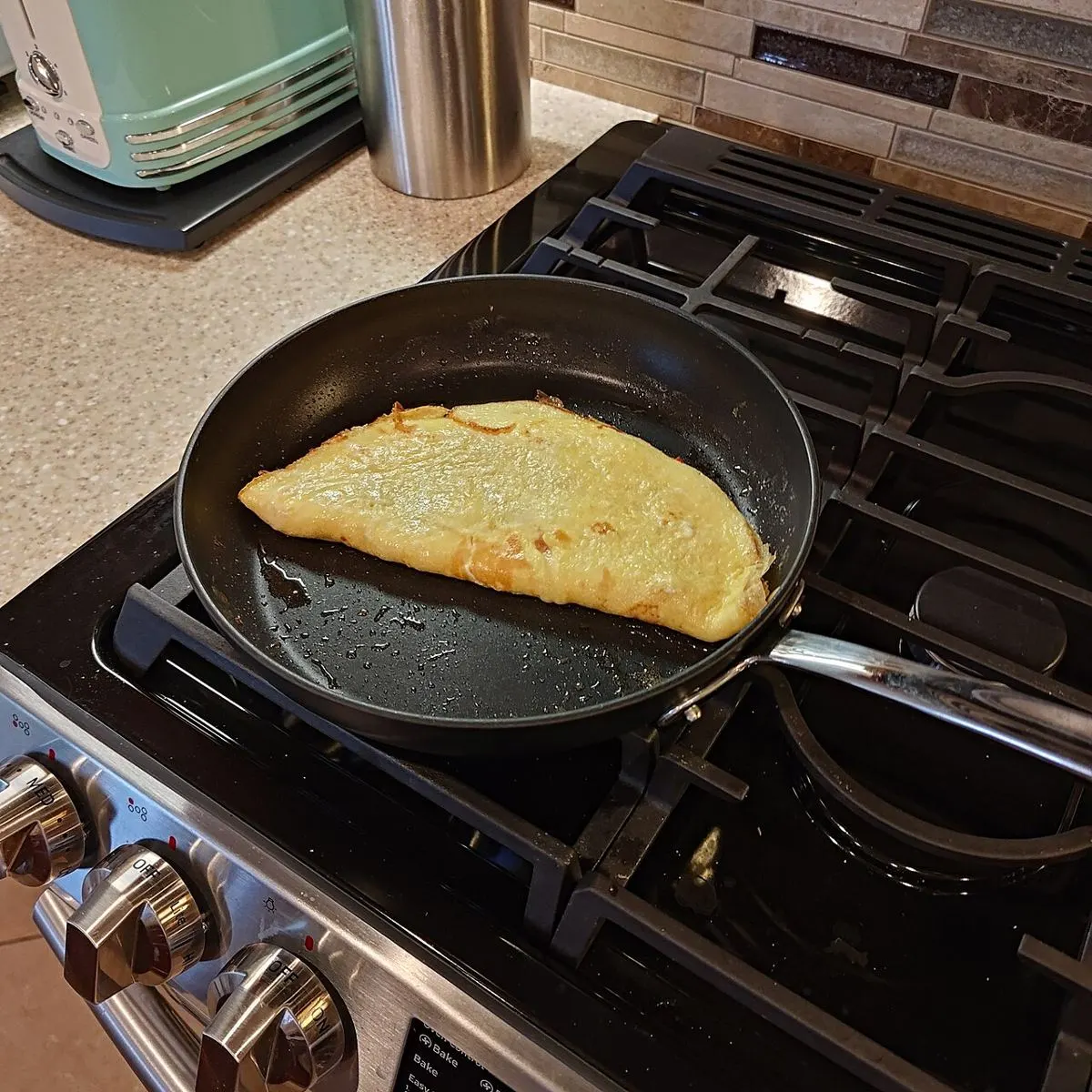
One pan, three lessons
Heat tightens protein
Egg white starts to set at around 63–65 °C (145–149 °F). As the heat rises, the protein tightens and loses water. That is why an omelet turns tough and dry over high heat.
The pan keeps cooking
The pan and the heat inside the eggs keep cooking the omelet after you take it off the burner. This is why you take the omelet off the heat while the top is still moist.
Movement gives texture
The spatula pulls the cooked part toward the center, so the liquid egg reaches the pan. That is why the omelet cooks evenly and does not burn.
What and how much
Grams are the real measure, and household measures are approximate. Too much egg in the pan makes a thick omelet that cooks unevenly. That is why you cook each omelet separately.
0.8% of 150 g of egg is about 1 g. That amount is one pinch of salt.
Chef's Essentials General salting: 0.8–1.2% of the dish's weight →Who should not eat undercooked eggs?
Pregnant people, older adults, young children, and anyone with a weak immune system should not eat undercooked eggs. Bacteria can survive in undercooked egg, so cook their omelets all the way through.
Seven steps, and heat matters most
Crack the eggs into a bowl and salt them
Crack the eggs into a bowl and add the salt.
Why? A piece of shell is easy to remove from a bowl and hard to remove from a pan. Salt also helps the eggs cook softer. That is why you salt the eggs in a separate bowl first.
Beat with a fork
Beat for 20–30 seconds, until the whites and yolks are one color. You do not need to make foam.
Why? Unmixed egg white cooks separately in the pan and leaves white spots in the omelet. That is why you beat the eggs until they are one color.
Heat the pan over medium heat
Heat the empty pan over medium heat for about 1 minute, until you feel warmth when you hold your hand above it.
Why? Eggs poured into a cold pan stick. A pan that is too hot sets the bottom of the eggs hard right away. That is why you heat the pan over medium heat.
Melt the butter
Put the butter in the pan. When it melts and foams, and before it browns, go to the next step.
Why? When the foam settles, the butter is close to burning. That is why the eggs go in while the butter is still foaming.
Pour in the eggs and pull the edges to the center
Pour the eggs into the pan and wait 10 seconds. Pull the edges to the center with the spatula, and tilt the pan so the liquid egg flows into the empty space. Keep doing this for about 1 minute, until little liquid egg remains and the top is moist.
Why? Liquid egg cooks when it touches the pan. So moving it this way cooks the omelet evenly.
Take it off the heat while the top is moist
Pull the pan off the burner when the bottom of the omelet has set and the top is shiny and slightly runny.
Why? The pan keeps cooking the omelet after you pull it off the burner. This is why an omelet that is fully cooked on the stove is dry on the plate.
Fold, slide onto a plate, taste
Fold the omelet in half with the spatula and slide it onto a plate. Taste a bite and sprinkle on salt if it needs it.
Why? You can only judge the salt and the heat by tasting. That is why the last correction comes after you taste.
What heat does to an omelet
Make two omelets. Cook one over medium heat and the other over high heat. Put the omelets side by side and taste a bite of each.
Omelet B is tougher and browner. At high heat, the protein tightens fast and pushes water out. In omelet A, the protein sets slowly and the water stays inside. That is why you cook eggs over medium heat. Chicken breast and fish dry out from overcooking for the same reason.
After one spoonful...
| If the dish is | Do this now | Next time |
|---|---|---|
| Tough and dry | Serve it with cheese or yogurt | Lower the heat and take it off the burner while the top is moist |
| Brown | Fold it so the brown side faces in | Pour in the eggs before the foam settles |
| Stuck to the pan | Lift it off in pieces with the spatula and serve it as scrambled eggs | Preheat the pan and do not cut back on the butter |
| Bland | Sprinkle on a pinch of salt | Salt the eggs when you beat them |
| Spotted with white | The taste is fine, so serve it as it is | Beat the eggs longer |
| Too runny in the middle | Turn off the heat, cover the pan, and wait 1 minute | Keep the pan on the heat a little longer |
If you know the omelet
Menemen
+ eggs soft-cooked with tomatoes and peppers, and the same heat rule applies to the eggs
Sucuklu yumurta
+ eggs fried with sucuk, a spiced Turkish beef sausage, and because sucuk is salty you use less salt
Tortilla
+ potatoes go in, and the heat is lower
Did you make it?
The first omelet may tear. The second one holds. The third one is lovely.
Up next: Week 2, rice and soup
Techniques: Heat control
If it goes wrong: Stuck to the bottom, smells burned · Bland, something is missing