Shepherd's salad (çoban salata) is a Turkish salad of tomato and cucumber cut into 1 cm cubes, with finely cut pepper and onion, tossed with salt, lemon juice, and olive oil 5 minutes before serving.
Allergens: none
Shepherd's Salad
People think a salad is never cooked. It is. Salt and lemon cook it, only without a flame.
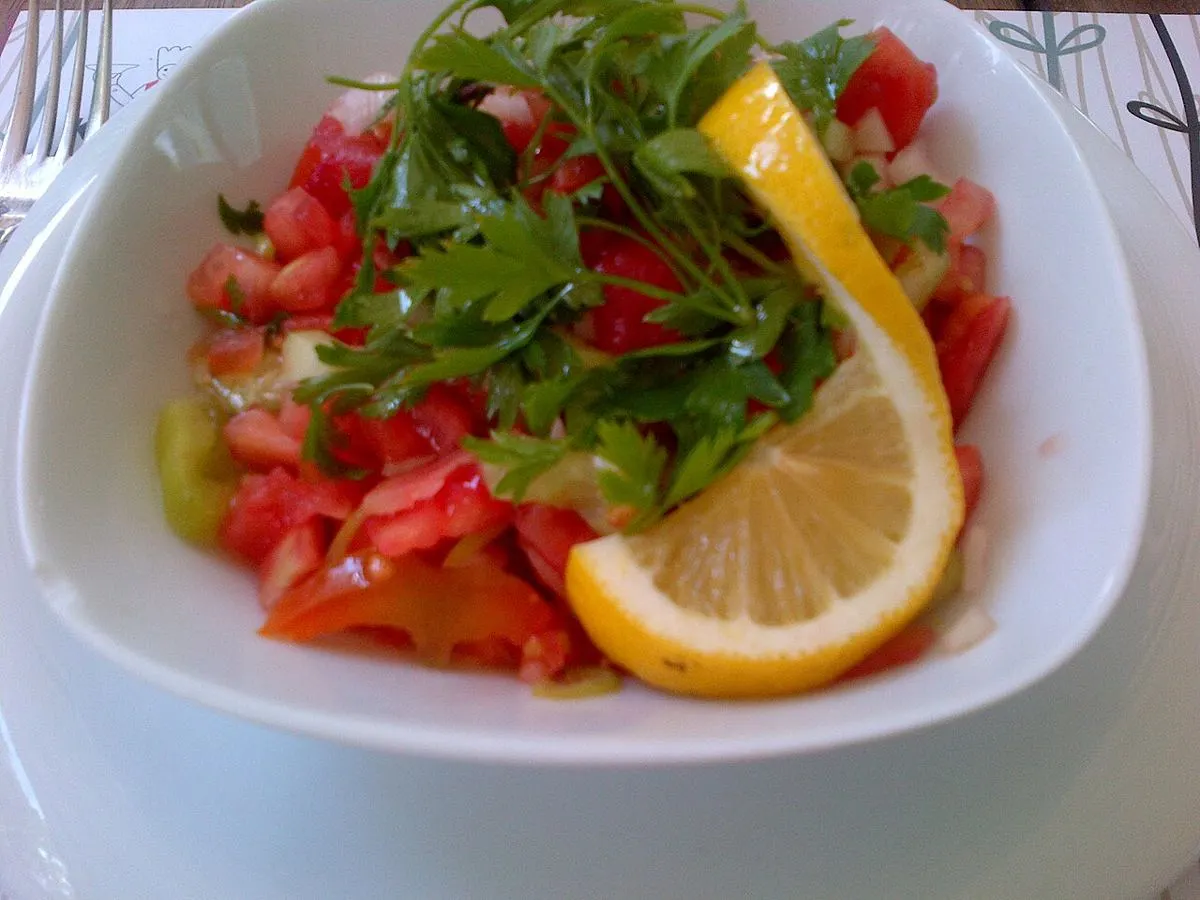
One bowl, three lessons
Same size, same bite
If every cube is about 1 cm, each spoonful brings tomato, cucumber, and pepper together. The taste of shepherd's salad comes from eating these ingredients in the same bite. That is why you cut the vegetables to the same size.
Salt pulls out water
Salt pulls water out of vegetables. If you salt early, vegetable water collects at the bottom of the bowl. That is why the salt goes in last.
Acid balances oil
Lemon juice balances the heavy taste of the oil and makes the tomato taste more distinct. When a salad tastes flat, the cause is usually too little acid.
What and how much
Grams are the main measure, and household amounts are approximate. A tsp is 5 ml and a Tbsp is 15 ml. If you have no measuring spoons, 5 ml is about 1 level dessert spoon. If you change the number of people, the amounts adjust on their own. Long green pepper (sivri biber) is a thin-walled Turkish pepper, usually mild. Look for it at a Middle Eastern grocery, or use Anaheim or cubanelle peppers. Small cucumbers here means thin-skinned ones such as Persian cucumbers. If yours are larger, go by the grams. Sumac is a ground dried red berry with a tart, lemony taste. You can find it at a Middle Eastern grocery or online. It is optional, so you can leave it out.
3 Tbsp (45 ml) olive oil, 1 Tbsp (15 ml) lemon juice. This is the same as the vinaigrette ratio in Chef's Essentials. Many salad dressings are built on this ratio.
Chef's Essentials Salad dressing ratios (oil : acid, by spoon) →Why is the salt 0.7%?
Raw vegetables get 0.7% salt because on raw food the salt touches your tongue directly. The general rule is salt at 0.8–1.2% of the food's weight. Raw vegetables taste saltier at that rate, so the rate drops to 0.7%. Shepherd's salad for 4 has about 865 g of vegetables and parsley. 0.7% of 865 g is 6 g, which is 1 tsp (5 ml).
Chef's Essentials Raw vegetables: 0.7% of their weight in salt →First your hand, then speed
This is the claw grip seen from the side. The hand holding the food is on the left, and the knife is on the right.
- The middle knuckle of your finger rests against the side of the blade. This knuckle guides the knife.
- Your fingertips curl inward and stay away from the blade.
Fingers flat, fingertip reaching under the blade.
If the knife slips, your fingertip is the first thing it cuts. That is why you always keep your fingers curled in.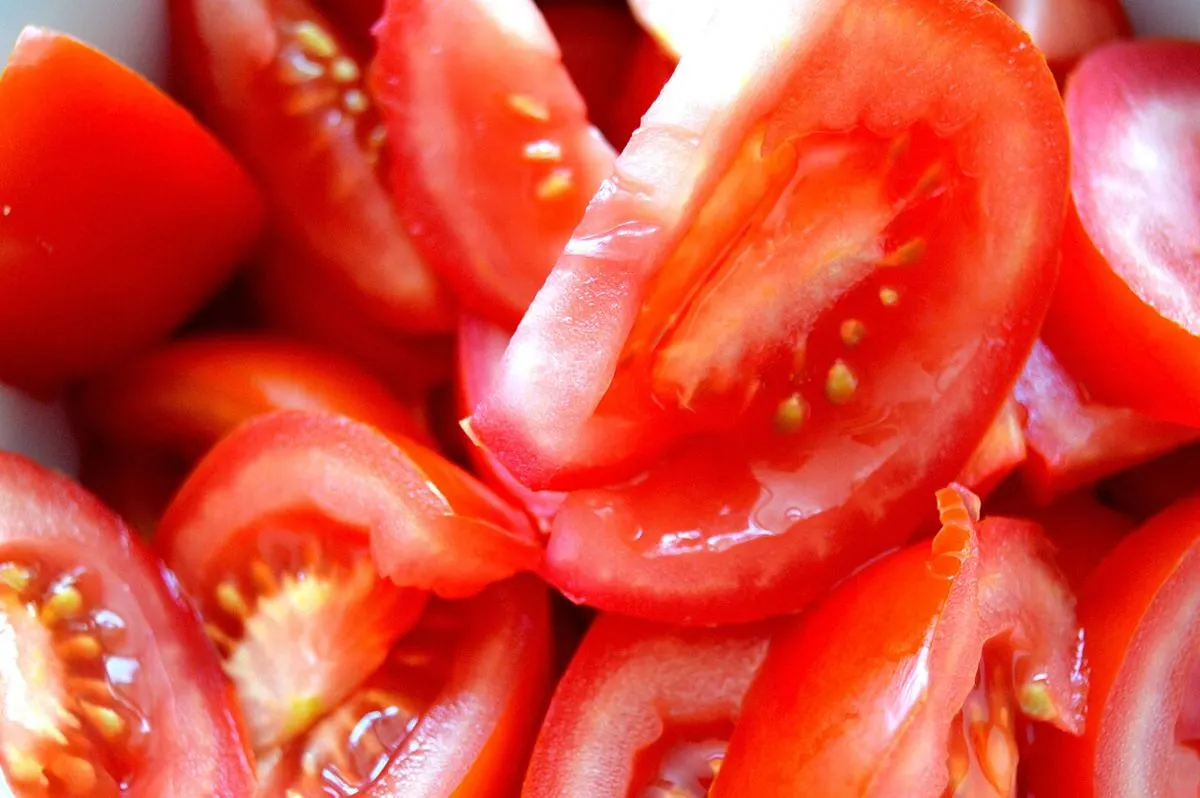
A dull knife slips. That is why a dull knife is more dangerous than a sharp one.
Claw grip
Curl in the fingertips of the hand holding the food. The side of the blade rests against your knuckles. This keeps your fingertips from ever getting close to the blade. See the drawing above.
Holding the knife
Do not hold the knife at the far end of the handle. Hold it where the handle meets the blade. Your thumb and index finger sit on either side of the blade. This grip gives you better control of the knife.
Dice: slice → stick → cube
First slice the vegetable 1 cm thick. Then cut the slices into sticks 1 cm wide, and cut the sticks into cubes. You make the same three moves on every vegetable.
Tomato skin is slippery
If you press the knife down on a tomato, the blade slides on the skin and crushes the tomato. So do not press. Cut by drawing the knife back and forth. If the tomato still crushes, the knife is dull. You can use a serrated knife until your knife is sharpened.
 Order is an ingredient too.
Seven steps, each with a reason
Cut the onion, rub it with salt, let it sit
Cut the onion into half-moons or 0.5 cm cubes. Rub it with a pinch of salt using your fingers and let it sit for 5 minutes. Then rinse it in cold water and squeeze it well.
Why? Salt pulls out the onion's sharp juice. Rinsing reduces the sharp smell. This way the onion does not overpower the other ingredients.
Cube the cucumber
Cut off the ends and taste a small piece from the end. If it is bitter, cut off a little more. Peel it or leave the skin on, as you like. Cut the cucumber into 1 cm cubes.
Why? A cucumber's bitterness collects at the ends. Tasting the end first keeps bitter pieces out of the salad.
Cut the pepper
Remove the stem and seeds. Cut the pepper into thin 3 mm rings or 0.5 cm cubes.
Why? Pepper is firm. A thin cut chews easily in the same bite as the other vegetables. That is why the pepper is cut smaller than the tomato.
Dry the parsley, then chop it
Wash the parsley and dry it well with paper towels. Remove the thick part of the stems. Chop by passing the knife over the leaves once.
Why? Wet parsley gets crushed under the knife and turns dark. Dry parsley cuts cleanly and stays green. That is why you dry the parsley before chopping.
Cut the tomato last
Cut the tomato into 1 cm cubes. Add the juice left on the board to the bowl too.
Why? The tomato is the juiciest ingredient. The earlier you cut it, the more water it releases. That is why the tomato is cut last.
5 minutes before serving: salt, lemon, oil
Put all the vegetables and the parsley in the bowl. Add the salt and lemon juice first, then the olive oil. Toss gently. Sprinkle sumac on top if you like.
Why? Salt pulls water out of vegetables. A salad salted early releases water until it reaches the table and turns watery. Salt does not dissolve in oil. It dissolves in lemon juice and spreads evenly through the salad. That is why the salt and lemon juice go in before the oil.
Taste a spoonful, adjust
Taste a spoonful of salad and adjust it using the table below. Every chef tastes before serving, and this rule has no exceptions.
Why? The sweetness of the tomatoes and the sourness of the lemon differ every time. So the recipe amounts are a starting point, and you make the final adjustment by tasting.
Does salt really pull out water?
Yes, and you can see it for yourself in 10 minutes. Cube a cucumber and divide it between two bowls. Add a pinch of salt to Bowl B and leave Bowl A alone. Wait 10 minutes and look at the bottom of each bowl.
Water collects at the bottom of Bowl B, and the cubes soften. Salt pulls the water out of the cells (osmosis). Bowl A stays crisp and dry. That is why a salad is salted last. The usul of salting meat ahead of time, which you will learn later, also depends on salt pulling out water.
When you taste a spoonful...
| If the salad is | Do this now | Next time |
|---|---|---|
| Flat, dull | First a pinch of salt. If that does not fix it, a few drops of lemon | Weigh the salt: 0.7% of the vegetables |
| Heavy, oily | A few drops of lemon | Keep the dressing ratio at 3:1 |
| Too sour | A drop of olive oil, a few cubes of tomato | Add lemon a little at a time |
| Onion overpowers everything | A little more tomato and cucumber | Rub the onion with salt and rinse it (step 1) |
| Water in the bowl | Drain the water and add back the dressing you lost | Add the salt 5 minutes before serving |
| Crushed tomatoes | The taste is not harmed, so accept it this time | Sharpen the knife or use a serrated knife |
| Something is missing, but what? | A pinch of sumac or a few drops of pomegranate molasses (a tart syrup of boiled-down pomegranate juice) | Try different sources of sourness |
Learn one salad and you can learn five more
Shepherd's salad belongs to a family. The salads in the family share one pattern, and only a few things change.
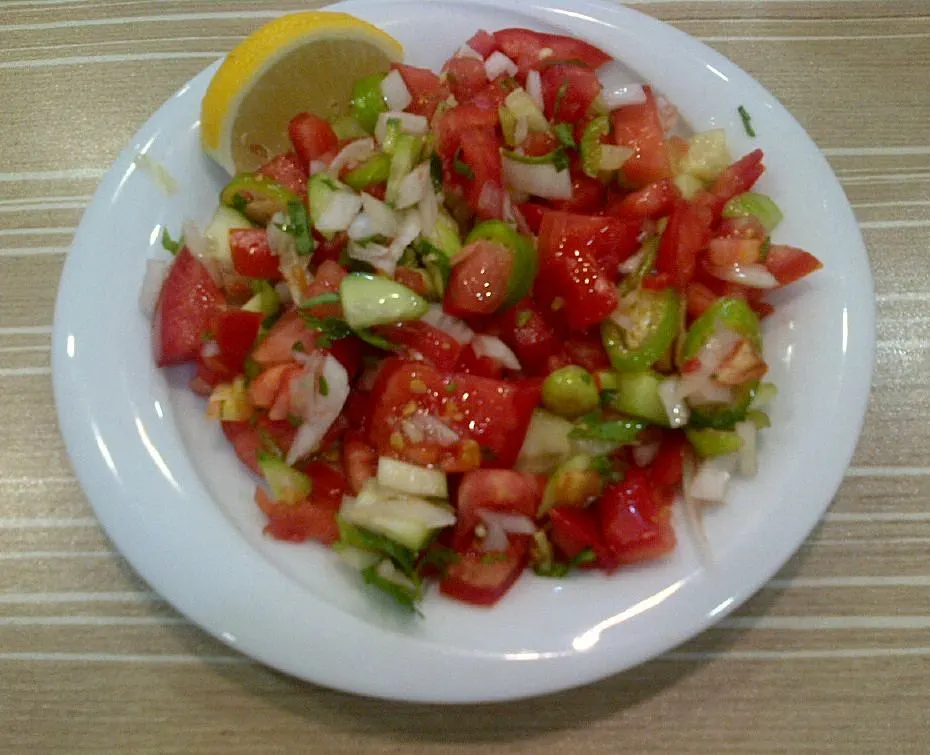
Did you make it?
Your first salad does not have to be perfect. It is enough to taste it and know what you would change.
Next: Omelet, your first meeting with heat
Techniques: Knife · Salt · Acid and balance
If it goes wrong: Too salty · Bland, something is missing · Too sour