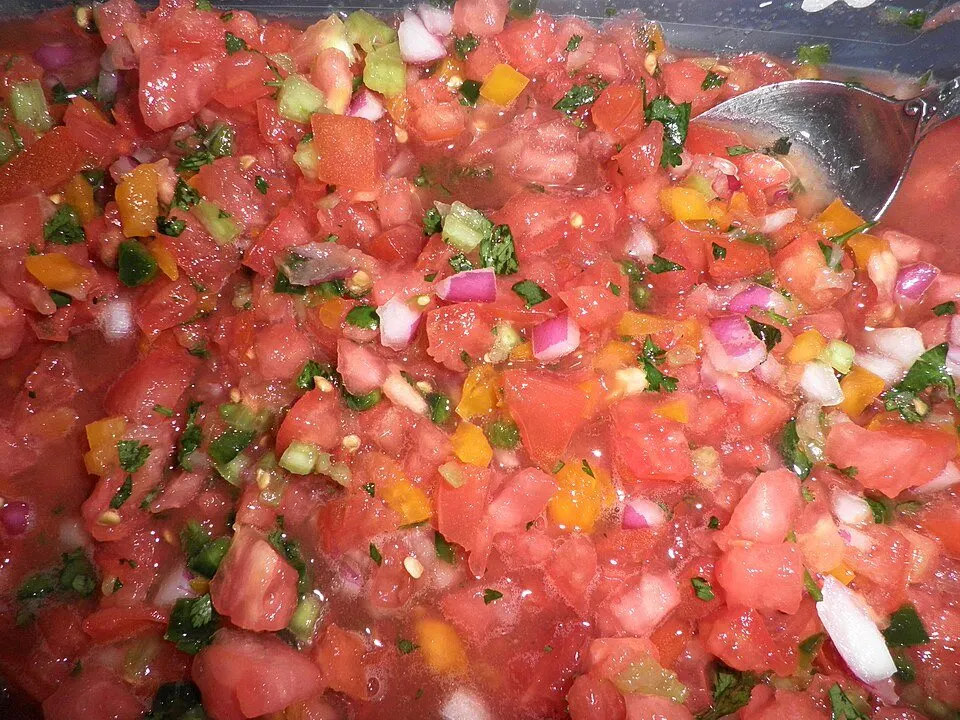
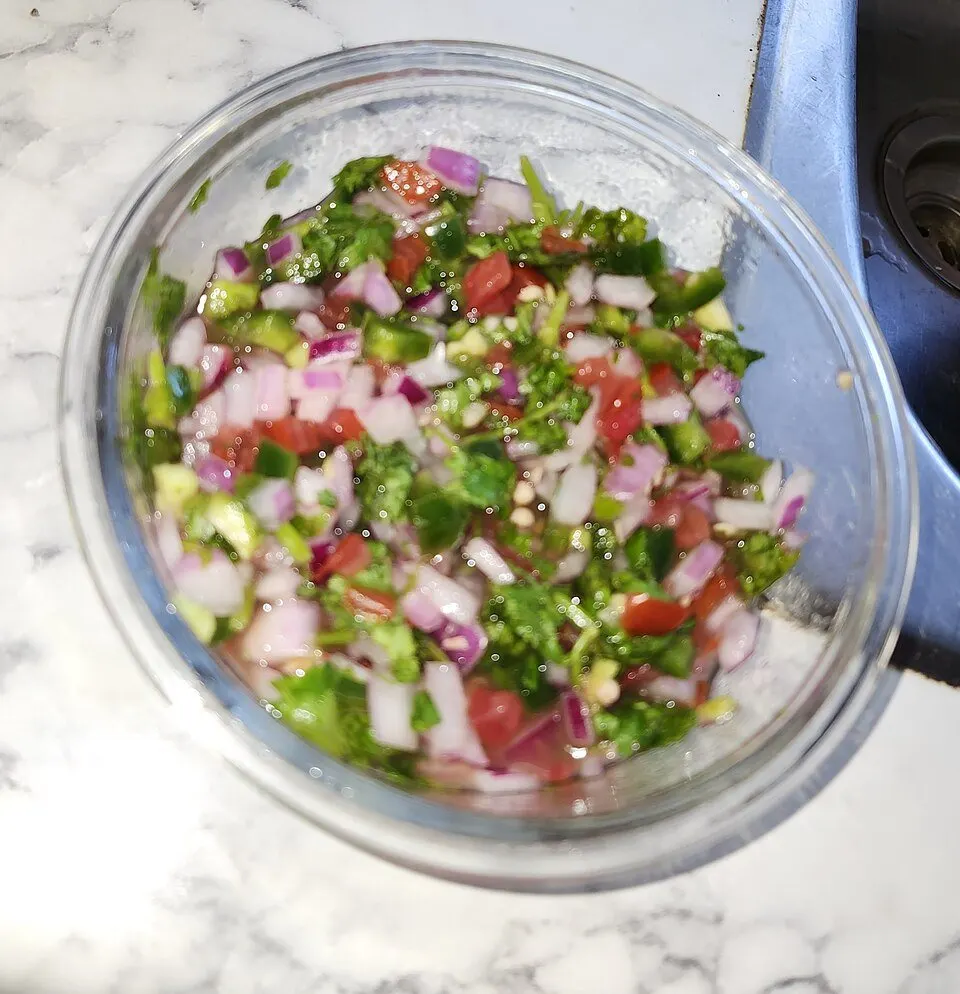
Pico de gallo is an oil-free Mexican fresh salsa made with salted and drained tomato, white onion, hot chili, cilantro, and lime.
Allergens: none
Pico de Gallo
The name means "rooster's beak." Ask why, and every cook in Mexico will tell you a different story.
The pattern is the same one you met in shepherd's salad (çoban salata), the Turkish chopped salad that opens this family. This time you are not making a side dish that sits on a plate. You are making a salsa that you spoon onto a taco. This page teaches two new things: how to control the heat of a chili, and how to draw the water out of tomatoes and throw it away.
Pico de gallo is the fresh, uncooked salsa of Mexican cooking. It is eaten with tacos, tortilla chips, grilled meat, and eggs. In Mexico it is also called "salsa fresca" (fresh salsa). Its red, white, and green colors look like the Mexican flag, so it is also called "salsa mexicana."
Four changes, four reasons
The pattern is the same: chopped raw vegetables + salt + acid + herb. The dice is again 0.5 cm. Here is what changes:
The tomatoes are salted and drained
You spoon pico onto a taco or a chip. Watery pico soaks the tortilla and drips from your hand. Salt pulls water out of tomatoes, as you learned in shepherd's salad. That is why the salt goes in first here, on purpose, and the water it draws out is drained off in a strainer and thrown away.
You control the heat
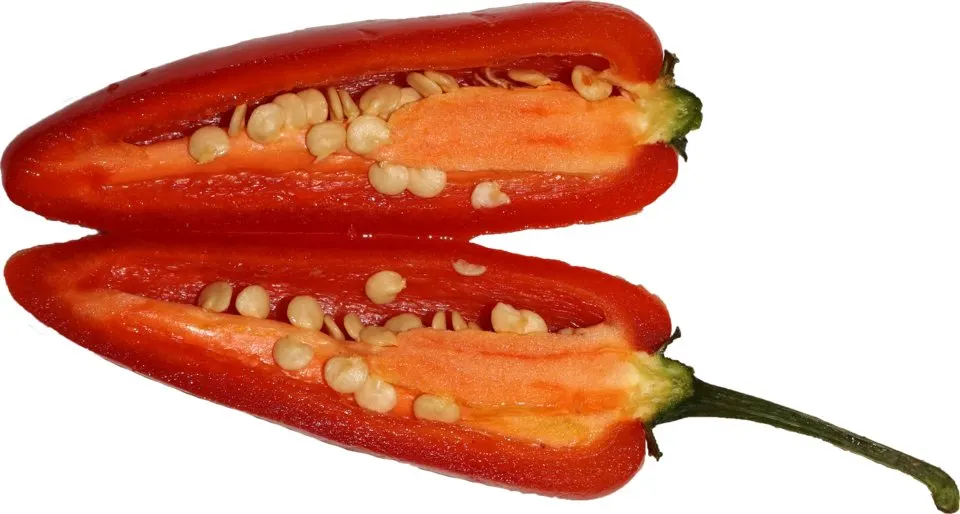
Most of a chili's heat is in the white membrane inside it. The seeds touch the membrane, so they become hot too. This is why you control the heat by leaving in or taking out the membrane and seeds.
The herb and the acid change
Cilantro smells sharper than parsley, and its scent is different. Lime also smells different from lemon. Cilantro and lime are basic flavors of Mexican cooking. So the first thing that separates pico from shepherd's salad is its smell.
No oil at all
Pico is eaten with rich foods: grilled meat, cheese, fried corn chips. The fat is already on the plate. Acid and chili heat balance that richness. That is why the salsa gets no oil.
Salt draws out water. So what happens to that water?
Each salad decides what to do with the water, even though salt does the same job in all four. Gavurdağı is a Turkish tomato salad with toasted walnuts and pomegranate molasses. Shirazi is an Iranian cucumber salad with lemon and dried mint.
| Salad | Is the water wanted? | Decision |
|---|---|---|
| Shepherd's | No | Salt goes in 5 minutes before serving, so water has no time to collect. |
| Gavurdağı | No | The juicy seed part of the tomato is removed from the start. |
| Shirazi | Yes | Salt goes in first, the salad rests, and the water becomes the dressing. |
| Pico de gallo | No | Salt goes in first, and the water is drained off in a strainer. |
What and how much
Grams are the real measure, and household measures are approximate. 1 tsp is 5 ml and 1 Tbsp is 15 ml. If you change the number of people, the amounts adjust on their own.
No oil, only lime. Oil has dropped through the family in this order: 3:1 in shepherd's salad, 1:3 in Shirazi, none in pico.
Chef's Essentials Salad dressing ratios (oil : acid, by spoon) →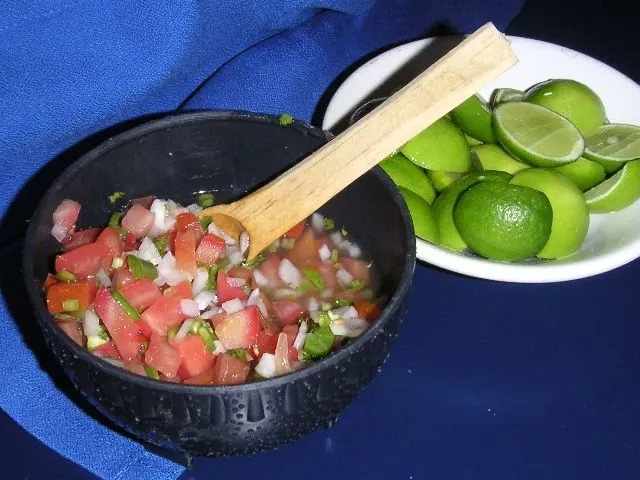
If you have no limes
Use a regular lemon. The smell of the salsa changes a little, but the sourness does the same job. So the pattern still holds.
Choose meaty tomatoes with few seeds, such as Roma. Go by the grams, because Roma tomatoes are smaller than the count in the list. Juicy tomatoes lose more water in the strainer, and their cubes fall apart.
Where is the heat in a chili?
Most of the heat is in the white membrane. The knife work is the dice you know, but for the chili the size drops to 3 mm. What is new is deciding which part of the chili to keep before you cut. Choose a heat level and look at the drawing to see which parts stay.
Taste a small piece first
Two chilies of the same kind can differ in heat. A small piece cut from the tip is milder than the part near the stem. So cut a piece from near the stem, taste it, and decide how much to use after you taste.
Protect your hands and eyes
The compound that makes chilies hot is called capsaicin. It stays on your fingers and does not rinse off easily with water. If it reaches your eyes or face, it burns. That is why you should wear thin gloves while cutting chilies, or wash your hands well with soap as soon as you finish.
Scrape out the membrane with a spoon
Cut the chili in half lengthwise. Use the tip of a small spoon to scrape out the membrane and seeds, working from the stem to the tip. A spoon tears away less flesh than a knife. So the flesh stays an even thickness and your cubes come out equal.
If you have no jalapeños
A serrano does the same job. Serranos are smaller than jalapeños and usually hotter, and heat varies from one chili to the next. So taste first. Decide how much to use by the heat you taste, not by the number of chilies.
Cilantro stems get used too
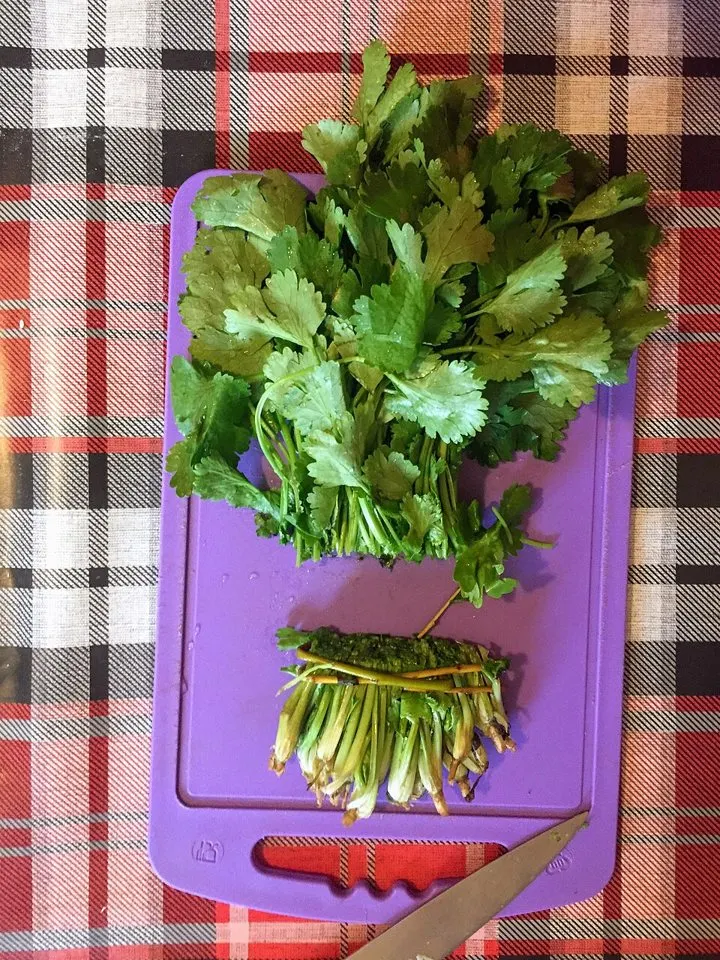
Thin stems smell as strong as the leaves
The thin stems of cilantro are soft and carry the same scent as the leaves. Chopped finely, they go unnoticed in the salsa. That is why you cut off only the thick, tough bottom part and chop the thin stems with the leaves.
Dry it, then chop it
The rule you learned with parsley applies here too: wet leaves crush under the knife and turn dark. So dry cilantro well after washing it.
Not everyone likes it
Some people taste soap in cilantro. This is an inherited difference that varies from person to person. So ask your guests first. For a guest who dislikes cilantro, make the pico with parsley and say that you used parsley.
Seven steps: salt comes first again, but the water leaves
You know this is a step you did in earlier salads. New is what makes this salad different.
Dice the tomatoes, salt them, and let them drain New
Dice the tomatoes into 0.5 cm cubes. Mix them with half of the salt, put them in a strainer, and set a bowl under it. Let them sit for 15 minutes, until water collects in the bowl below. Shake the strainer gently now and then.
Why? Salt pulls water out of tomatoes. In Shirazi you kept this water in the bowl, but here the strainer separates it from the tomatoes. That is why the pico does not soak the tortilla when it goes on a taco.
Finely chop the white onion and rinse it in cold water You know this
Chop the onion to 0.5 cm or smaller. Rinse it under cold water in a strainer and squeeze it well.
Why? Rinsing reduces the sharp smell of onion, as you saw in shepherd's salad. Pico has a high share of onion. So you do not skip this step.
Taste the chili, decide on the membrane, and chop it finely New
Taste a small piece from near the stem. Using the heat guide above, leave in the membrane and seeds or scrape them out with a spoon. Dice the chili smaller than the other ingredients, into 3 mm cubes.
Why? When the chili is cut smaller than the other vegetables, its heat spreads evenly through the salsa. A large piece burns in a single bite. That is why the chili is the most finely chopped ingredient.
Dry the cilantro and chop it with its stems New
Cut off the thick bottom part. Chop the thin stems and leaves together, going over them two or three times.
Why? Thin stems smell as strong as the leaves. Dried cilantro cuts without crushing and stays green. So you dry the cilantro and chop it with its stems.
Combine and add the lime You know this
Mix the drained tomatoes, onion, chili, and cilantro. Squeeze the lime juice over them. Do not add salt yet. Taste first.
Why? Half of the salt went on the tomatoes, and some of it left with the drained water. You cannot know how much salt remains in the tomatoes. That is why you add the rest of the salt only after tasting.
Taste the heat and adjust it New
Taste a spoonful. If there is too little heat, add a bit more chopped chili. If there is too much, add a bit more tomato and onion.
Why? You cannot take heat back out. You can only dilute it. That is why you add chili a little at a time and taste each time.
Finish the salt and serve right away You know this
Add a pinch of salt if it needs it. Serve with tacos, tortilla chips, grilled meatballs, or grilled chicken.
Why? Even drained tomatoes slowly release water again after mixing. So eat pico within an hour of making it.
Taste where the heat is
Before you start, set a glass of milk or a spoonful of yogurt beside you. Cut a chili in half lengthwise. Tear off a piece of flesh the size of a grain of rice, one that has not touched the membrane, and taste it with the tip of your tongue. Drink some water and wait one minute. Then taste a piece of membrane the same size.
Piece B is much hotter. Use the milk or yogurt beside you to ease the burn. The capsaicin that makes a chili hot is produced in its membrane. Very little of it passes into the flesh, but it does get onto the seeds that touch the membrane. Drinking water does not stop the burn, because capsaicin barely dissolves in water. The fat and protein in milk and yogurt take capsaicin off your tongue. That is why a spicy dish is often served with yogurt or ayran, a salty Turkish yogurt drink.
Match each rule to its salad
You now know four salads. Choose the one each rule belongs to.
The tomatoes are salted and left in a strainer.
It goes on a taco, so water is not wanted. It is drawn out and thrown away first.
The liquid at the bottom is eaten with a spoon.
The water drawn out by salt mixes with lemon and becomes the dressing.
The acid is thick and slightly sweet.
Pomegranate molasses is pomegranate juice boiled down until thick.
The heat is set by keeping or removing the chili's membrane.
Most of the heat is in the membrane.
The oil is three times the acid.
3:1 is the vinaigrette ratio. Pico has no oil at all.
A dried herb is rubbed between the palms and goes into the dressing first.
The scent of dried mint passes into a liquid only once the mint is wet.
After one spoonful...
| If the pico is | Do this now | Next time |
|---|---|---|
| Too hot | Add more tomato and onion to dilute the heat | Scrape out the membrane and add the chili a little at a time |
| Not hot at all | Add a bit more chili, this time with its membrane | Taste the chili first (step 3) |
| Watery, dripping from the chip | Serve with a slotted spoon | Salt the tomatoes and leave them in the strainer for 15 minutes |
| Tomato cubes falling apart | Let it go this time. The flavor is fine | Choose meaty tomatoes and do not press them in the strainer |
| Flat | Add a pinch of salt first, then a few drops of lime | Finish the salt by tasting after draining |
| Too much onion | Add a bit more tomato | Rinse the onion in cold water and squeeze it |
| Cilantro tastes like soap | Cilantro cannot be taken out. Make a small separate bowl with parsley for that person | Ask your guests first |
Six salads, one pattern
Each page changes one part of the pattern. If you go in order, each salad differs from the last by only a few things.
Next: Horiatiki. The cut gets large for the first time, white cheese and olives come in, and the added salt drops.
Did you make it?
Four bowls, four verdicts on the water. The salt never changed. You did the deciding.
Techniques: Knife · Salt · Acid and balance
If it goes wrong: Too spicy (chili) · Bland, something is missing