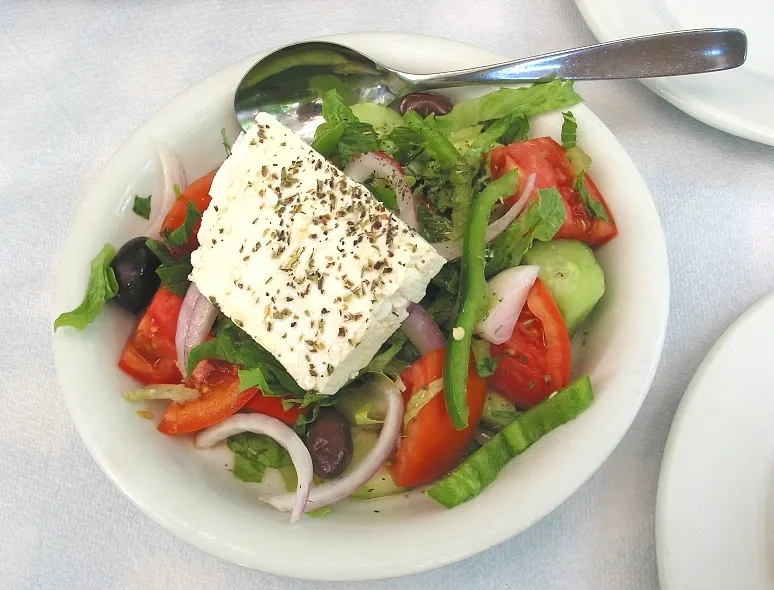
Horiatiki is the Greek village salad of large-cut tomato, cucumber, and olives topped with a block of feta-style white cheese. The classic recipe has no lettuce.
Allergens: milk
Horiatiki
A village salad. A slab of cheese in the middle, and at the bottom, oil that is waiting for bread.
Until now the pieces kept getting smaller. In this salad they get large for the first time. You also add very little of the salt yourself, because the cheese and olives bring it. This page teaches large cutting and how to work out the salt when salty ingredients are in the bowl.
The Greek word "horiatiki" means "of the village." Horiatiki is the main summer salad on Greek tables. Eaten with bread, it nearly replaces a meal. The classic recipe has no lettuce.
Four changes, four reasons
Shepherd's salad (çoban salata) is the Turkish chopped salad that opens this family. The pattern is the same: chopped raw vegetables + salt + acid + oil + herb. Here is what changes:
The cut gets larger
In Gavurdağı, a Turkish tomato and walnut salad, the smaller dice gave more cut surface. Here the opposite happens: a large piece has little cut surface, so it keeps its water inside. That is why Horiatiki gives off less water and you taste each piece separately.
The ingredients bring the salt
Feta-style white cheese and olives are both kept in brine, so both are salty. This soft, salty cheese is sold as feta, and Greek feta is the right choice here. Turkish beyaz peynir, from a Middle Eastern grocery or online, works the same way. Buy a block, not crumbles. Most of the salt in the salad comes from the cheese and olives. So you add almost no salt, only a pinch sprinkled over the tomatoes.
The cheese is not crumbled
Crumbled cheese mixes with the dressing, clouds it, and spreads its salt through the whole salad. From a block, you take as much as you want in each bite. That is why the cheese goes on top of the salad as one thick slice.
More oil, less acid
Tomatoes and white cheese are already slightly sour. Bread gets dipped in the oil and tomato juice left at the bottom of the bowl. So the oil is generous and the vinegar is small, and sometimes there is no vinegar at all.
Firm goes thin, juicy goes large
Each ingredient in this salad is cut to a different size. The size depends on how firm and how juicy the ingredient is.
Water and salt pass through the cut surface. As the piece gets larger, the same amount of tomato has less cut surface. That is why a large-cut tomato keeps its water inside.
Tomato: large wedges
Remove the core and cut the tomato into 8 wedges. Cut long pieces in half. Tomato is soft and juicy, and a large piece keeps its juice inside. That is why tomato is cut large.
Cucumber: thick half-moons
Peel the cucumber in strips, cut it in half lengthwise, and slice it into half-moons 1 cm thick. A thick slice stays crunchy. So do not cut the cucumber thin.
Pepper and onion: thin rings
Cut the green pepper and red onion into 3 mm rings. Raw pepper is firm and raw onion is sharp. Cut thin, they chew easily and do not overpower the other ingredients. That is why pepper and onion are the most thinly cut ingredients in the salad.
Cheese: one thick slice
Cut the block of cheese into a slice 1.5 cm thick and about the size of your palm. Cheese does not stick to a wet knife, so the slice does not break. That is why you wet the knife before cutting.
What and how much
Grams are the real measure, and household measures are approximate. 1 tsp is 5 ml and 1 Tbsp is 15 ml. If you change the number of people, the amounts adjust on their own.
Salt math
A salad for 4 has about 900 g of vegetables. At the shepherd's salad rate (0.7%), that would need 6 g of salt.
200 g of white cheese brings about 5 g of salt, and 80 g of olives brings about 2 g (this varies by brand). That is about 7 g in total, which is more than needed.
But the salt in the cheese and olives stays inside them and does not pass into the tomatoes. A bite of tomato without cheese tastes flat. That is why you sprinkle one pinch (1 g) of salt over the tomatoes only.
Chef's Essentials Raw vegetables: 0.7% of their weight in salt →4 Tbsp olive oil, 1 Tbsp red wine vinegar. Horiatiki has the oiliest dressing in the family. If you have no vinegar, leave it out or use a few drops of lemon.
Chef's Essentials Salad dressing ratios (oil : acid, by spoon) →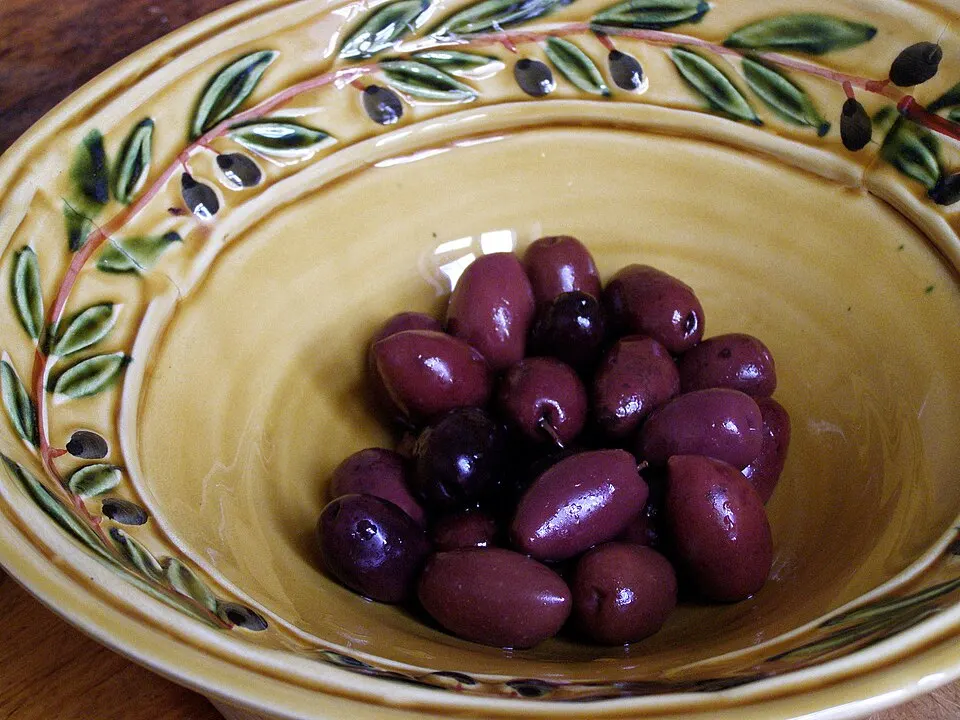
Olives: large, with pits
In Greece, Kalamata olives are used: purple-brown, large, and meaty. If you cannot find Kalamatas, use large black olives packed in brine. An olive with its pit stays whole in the salad and keeps its salt in the flesh.
Tell people at the table that the olives have pits. Someone who does not notice a pit could break a tooth.
The tree takes a century. The olive takes one bite.
Seven steps: no stirring, one turn
You know this is a step you did in earlier salads. New is what makes this salad different.
Cut the tomatoes large and add a pinch of salt New
Cut the tomatoes into wedges and halve the long pieces. Spread them in a wide bowl or on a platter and sprinkle a pinch of salt over them.
Why? The salt in the cheese and olives does not pass into the tomatoes. Unsalted tomato tastes flat in a bite without cheese. That is why the only salt you add goes on the tomatoes.
Cut the cucumber into thick half-moons New
Peel it in strips, cut it in half lengthwise, and slice it 1 cm thick. Taste the ends of the cucumber, because they can be bitter.
Why? A thick slice stays crunchy and is the same bite size as the large tomato pieces. So you cut the cucumber thick. You know the check for bitter ends from shepherd's salad.
Cut the pepper and onion into thin rings New
Cut the pepper and onion into 3 mm rings. You do not need to rinse the onion, because its sharpness is mild in a thin ring.
Why? Firm, sharp ingredients chew easily and do not overpower other flavors when cut thin. That is why pepper and onion stay thin, even in a salad with large pieces.
Turn the vegetables and olives once New
Add the cucumber, pepper, and onion to the bowl with the tomatoes, then add the olives. With both hands or two spoons, turn everything once from bottom to top. Then leave it alone.
Why? Stirring crushes large pieces of tomato, and they release their juice. That is why you do not stir Horiatiki. You turn it only once.
Place the cheese on top in a block New
Lay the 1.5 cm thick slice in the center of the salad.
Why? Crumbled cheese clouds the dressing and spreads its salt everywhere. From a block, you take as much as you want in each bite. So you do not crumble the cheese.
Rub the oregano in your palms and sprinkle it over the cheese You know this
Crumble the dried oregano between your palms so that most of it lands on the cheese.
Why? You know palm-rubbing from Shirazi, the Iranian cucumber salad: breaking the leaf releases its scent. A dried herb gives off its scent when liquid wets it. Here that liquid is the oil you pour over the cheese in the next step. That is why the oregano goes on before the oil.
Drizzle the oil and vinegar, and taste with the cheese You know this
Drizzle the vinegar over the vegetables, and drizzle most of the olive oil over the cheese and oregano. Taste with a piece of cheese on your fork. Serve with bread.
Why? Horiatiki's salt is in the cheese. A bite tasted without cheese makes the salad seem flatter than it is. That is why you always take some cheese when tasting.
Find where the salt comes from
Before you salt the tomatoes, prepare three bites. The first bite is one piece of tomato alone. For the second bite, put a small piece of white cheese next to the tomato. For the third bite, put an olive next to the tomato. Taste the bites in order.
A tastes flat. B and C are salty enough with no added salt. In your mouth, the salt comes from the salty ingredient in the same bite. That is why, in any dish with a salty ingredient, you reduce the salt and taste with that ingredient included. Examples are peynirli börek (a Turkish cheese pastry), a salad with olives, and eggs with pastırma (Turkish air-dried cured beef).
Check a store-bought salad against the pattern
This salad is sold in a supermarket as "Greek salad." Choose the ingredients that belong to the pattern.
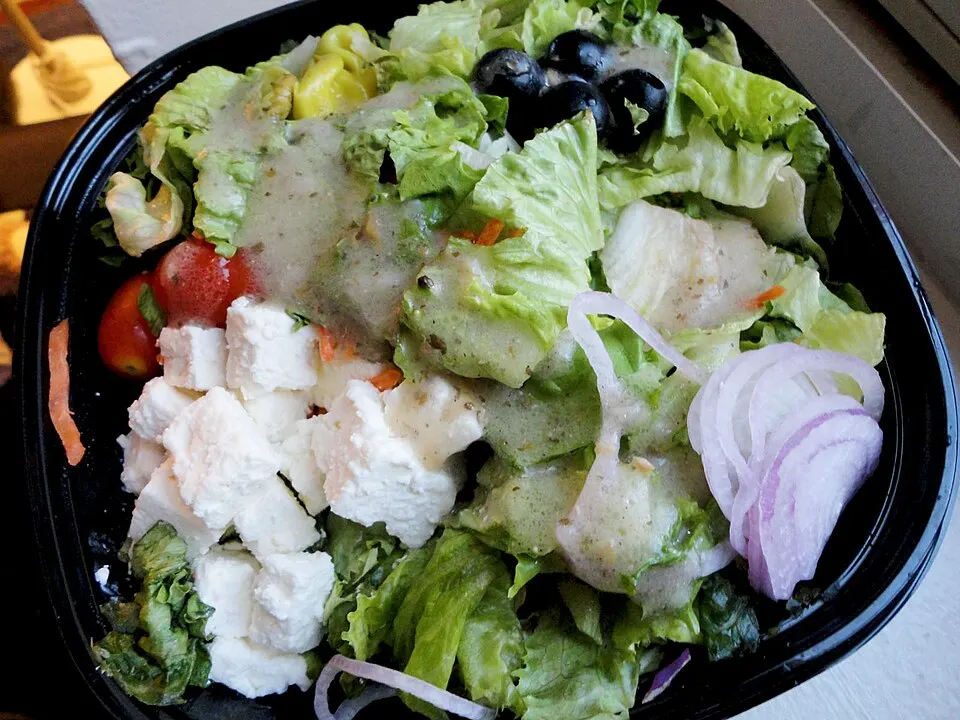
These belong to the pattern: tomato, white cheese, onion, olives. The lettuce and creamy dressing were added later. Classic Horiatiki has no lettuce. When lettuce goes in, leaves make up most of the salad and the tomato's share drops. Creamy dressing covers the taste of the olive oil and tomato.
Even with some correct ingredients, the way they are used has left the pattern. The cheese is cubed and scattered, not left in a block. So its salt spreads everywhere. There is almost no cucumber or pepper. That is why this plate may be called "Greek salad," but it does not taste like Horiatiki.
Salt draws out water. The fifth decision:
| Salad | Is the water wanted? | Decision |
|---|---|---|
| Shepherd's | No | Salt goes in 5 minutes before serving. |
| Gavurdağı | No | The juicy seed part of the tomato is removed. |
| Shirazi | Yes | Salt goes in first, the salad rests, and the water becomes the dressing. |
| Pico de gallo | No | Salt goes in first, and the water is drained off in a strainer. |
| Horiatiki | A little, for bread | The large cut and small amount of salt draw out little water. Bread is dipped in the oily juices left at the bottom. |
After one spoonful...
Take some cheese on your fork when you taste.
| If the salad is | Do this now | Next time |
|---|---|---|
| Too salty | Add more tomato and cucumber | Taste the cheese first. If it is very salty, soak it in water for 30 minutes |
| Flat in bites without cheese | Sprinkle one more pinch of salt over the tomatoes | Salt the tomatoes (step 1) |
| Watery in the bowl | Bring bread and dip it in the juices | Cut the tomatoes large. Do not stir, turn once |
| Crushed tomatoes | Let it go this time | Turn once, do not stir |
| No smell of oregano | Rub a pinch of oregano in your palms and add it | Add the oregano before the oil, so the oil wets it |
| Too much onion | Pick out some of the rings | Cut the onion thinner |
| Heavy and oily | Add a few drops of vinegar or lemon | Keep the oil at the 4:1 ratio |
Six salads, one pattern
Each page changes one part of the pattern. If you go in order, each salad differs from the last by only a few things.
Next and last: Fattoush. Toasted bread goes into the salad, and sumac comes back. Bread softens in the dressing, so timing starts to matter.
Did you make it?
The knife grew, the salt shrank, and the pattern never moved. Keep the bread close.
Techniques: Knife · Salt
If it goes wrong: Too salty · Bland, something is missing