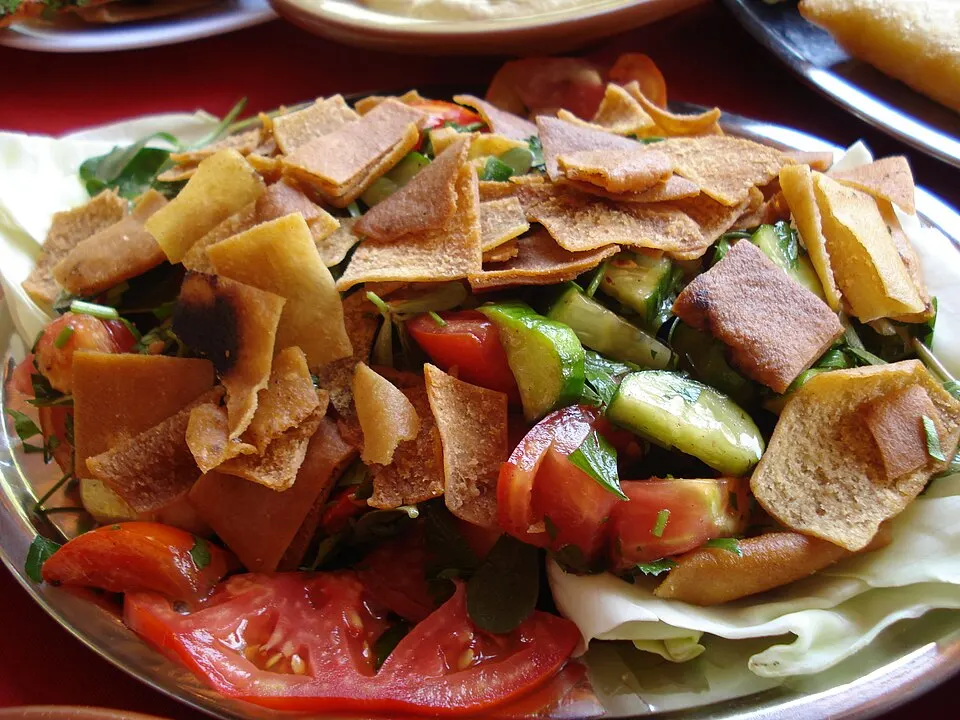
Fattoush is an Eastern Mediterranean (Levantine) salad of oven-dried pita and plenty of greens. It is combined at the moment of serving with a sour dressing of lemon, pomegranate molasses, and sumac.
Allergens: gluten
Fattoush
The salad of kitchens where stale bread never meets the trash. It dries, it toasts, and it comes back to the table in a bowl.
Fattoush is the last salad in the family. It gathers the acids and herbs of the earlier salads into one bowl: sumac, pomegranate molasses, lemon, fresh herbs. The big new ingredient is bread. With bread comes a new lesson: timing.
Fattoush is a salad of Lebanese, Syrian, and Palestinian cooking. In Turkey it is also made in the cooking of Hatay, near the Syrian border. Its name comes from the Arabic root "fatt" (to crumble, to break). Other dishes made with broken bread take their names from the same root. Tirit, a hot Turkish dish of stale bread soaked in meat broth, is the same idea served warm.
Four changes, four reasons
Shepherd's salad (çoban salata) is the Turkish chopped salad that opens this family. The pattern is the same: chopped raw vegetables + salt + acid + oil + fresh herb. This time one ingredient joins the pattern. Here is what changes:
Bread comes in, so timing starts to matter
Bread absorbs dressing. As it does, the edges soften first and then the middle. Its texture keeps changing from the moment it enters the bowl. That is why Fattoush is combined at the moment of serving and eaten right away.
Sourness comes from three sources
Lemon is sharp and fresh. Pomegranate molasses, a thick syrup of boiled-down pomegranate juice, is dark and slightly sweet. Sumac, a ground dried red berry, is dry and slightly astringent. You can buy both at a Middle Eastern grocery or online. In place of the molasses, use lemon juice with a little honey. In place of sumac, use grated lemon zest. Each one adds its own flavor to the sourness. Bread is bland and reduces the sourness of the salad as it absorbs dressing. That is why this dressing is built more sour than the one for shepherd's salad.
The greens multiply
In Fattoush, greens are one of the main ingredients: lettuce, parsley, fresh mint, scallions, and purslane in season. Oil does not cling to a wet leaf, so the dressing runs to the bottom. That is why you dry all the leaves well after washing them.
The dressing starts with garlic
Chopped garlic stays in pieces in the dressing. One bite burns with garlic and the next has none. Salt grains crush the garlic under the knife and turn it into a paste. The paste spreads evenly through the dressing. That is why you do not chop the garlic. You crush it with salt.
How long has the bread been in the dressing?
About 2 minutes is the best moment, because the edges have softened and the middle is still crisp. Drag the slider to see what happens inside the bread. The times are approximate and depend on the thickness of the bread.
Dry it first
The inside of fresh bread is moist, and it turns doughy when it absorbs dressing. Heat evaporates the water inside the bread and hardens its surface. Dry bread takes up dressing without falling apart. That is why even stale bread goes in the oven to dry before it enters the bowl.
Oil protects the bread
Before the oven, toss the bread pieces with a little olive oil. The oil coats the surface and slows the dressing from getting inside. So bread toasted with oil stays crisp longer.
What and how much
Grams are the real measure, and household measures are approximate. 1 tsp is 5 ml and 1 Tbsp is 15 ml. If you change the number of people, the amounts adjust on their own.
3 Tbsp olive oil, 2 Tbsp lemon juice, 1 Tbsp pomegranate molasses. That is 3 spoons of oil and 3 spoons of acid in total. Sumac goes on top. This dressing is more sour than the 3:1 of shepherd's salad, because the bread reduces the sourness.
Chef's Essentials Salad dressing ratios (oil : acid, by spoon) →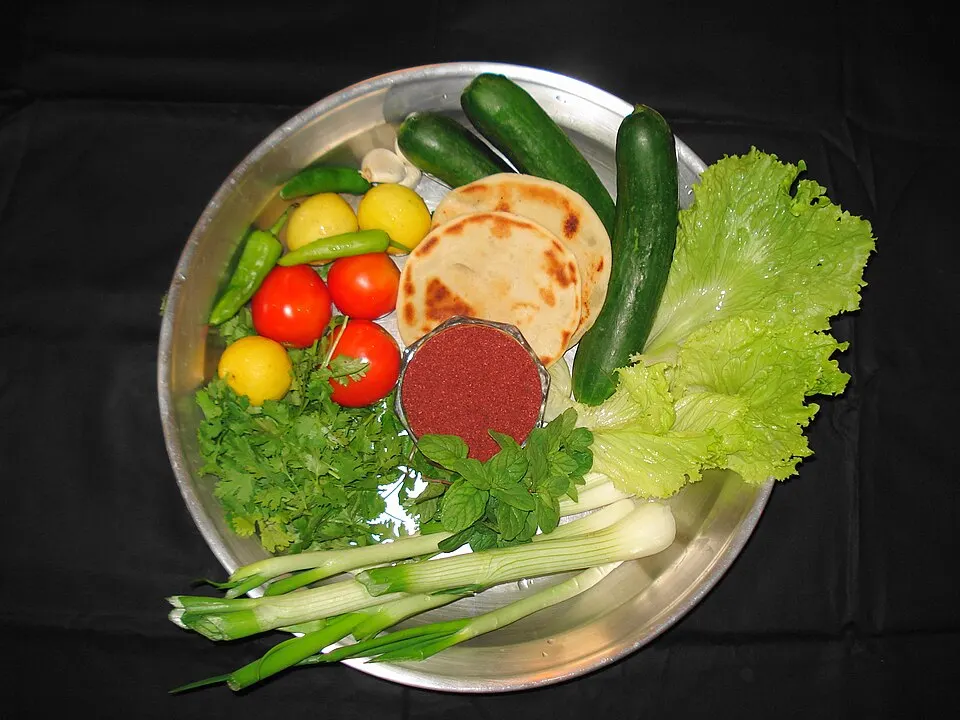
Bread: thin pita or lavash
Thin, two-layered Arab bread (pita) works best: when the layers separate, you get thin, crisp pieces. Lavash, a thin soft flatbread sold at Middle Eastern groceries, is the next choice. You can also use pita that is two or three days old.
Thick bread with a soft crumb absorbs dressing too fast and turns doughy.
Dry leaves, clean dressing
Wash, then dry well
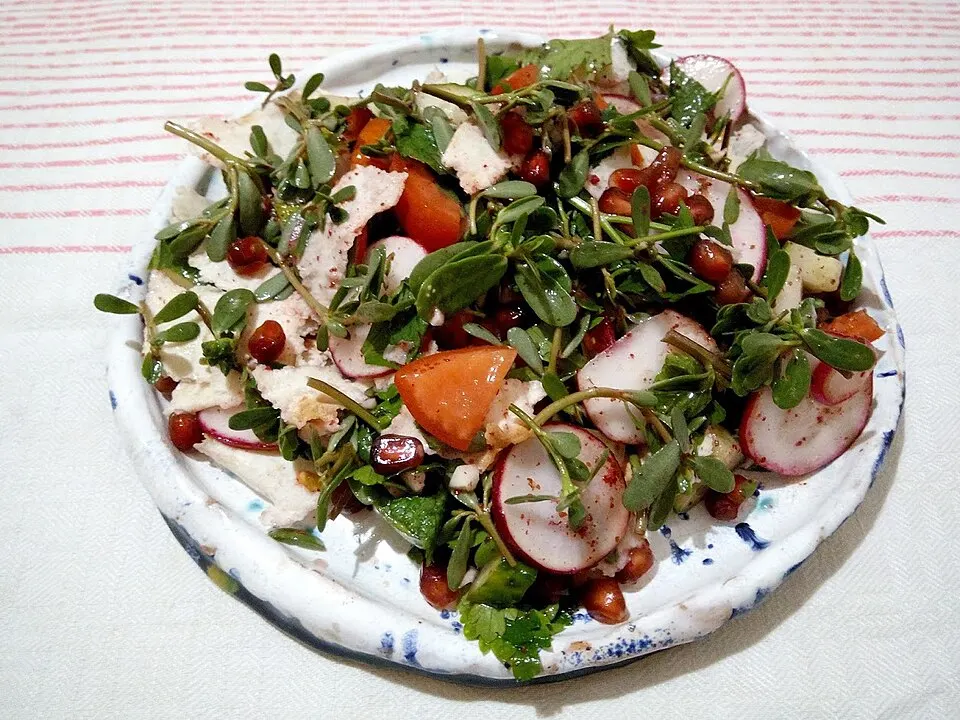
Water left on a leaf repels oil, so the dressing does not cling and runs to the bottom of the bowl. That is why you dry the greens before cutting them. If you have no salad spinner, shake the leaves gently in a clean kitchen towel.
Keep the mint as leaves
Fresh mint turns dark quickly when it is crushed under a knife. Leave small leaves whole and tear large ones in half by hand. So you do not chop the mint.
Vegetables the size of the bread
Cut the tomato and cucumber into 2 cm pieces: smaller than in Horiatiki, larger than in shepherd's salad. The bread pieces are this size too. So one forkful picks up vegetable and bread together. Radish is firm and sharp, so it is cut thin.
If you find purslane
Purslane is the traditional leaf of Fattoush. It is a small, fleshy summer green sold at farmers' markets and at Mexican groceries as verdolagas. If you cannot find it, leave it out. Remove the thick stems and use the leaves and thin stems. The mild sourness of purslane adds to the acid in the salad.
Seven steps: the bread is prepared first and goes in last
You know this is a step you did in earlier salads. New is what makes this salad different.
Tear the bread, oil it, and dry it in the oven New
Split the pita into its layers and tear it into 2–3 cm pieces. Mix them with 1 Tbsp (15 ml) of olive oil and spread them in a single layer on a tray. Dry them in a 180 °C (350 °F) oven until golden, 8–10 minutes. Let them cool on the tray.
Why? Heat evaporates the water inside the bread and browns its surface. The browning reaction you saw when toasting walnuts (the Maillard reaction) happens here too: the color deepens and a toasted smell comes out. That is why the bread turns both crisp and fragrant.
Crush the garlic with salt and whisk the dressing in a separate bowl New
On a board, crush the garlic with the salt using the flat side of a knife until you have a paste. Put the paste in a bowl. Add the lemon juice, pomegranate molasses, and half of the sumac, then whisk in the remaining 3 Tbsp of olive oil.
Why? Salt does not dissolve in oil, and pomegranate molasses is thick. That is why you whisk the dressing in a separate bowl, as you did for Gavurdağı, the Turkish tomato and walnut salad. This also spreads the garlic paste evenly through the dressing.
Wash the lettuce and herbs, and dry them well You know this
Wash the leaves and dry them well. Then tear the lettuce into 2–3 cm pieces. Coarsely chop the parsley, pick the mint leaves, and thinly slice the scallions.
Why? Dressing does not cling to a wet leaf. You learned to dry parsley in shepherd's salad. So the same rule applies here to all the leaves.
Cut the tomato and cucumber to 2 cm, and slice the radish thin You know this
Taste the ends of the cucumber, then cut it into 2 cm pieces. Slice the radishes into half-moons 3 mm thick. Cut the tomato last, into 2 cm pieces.
Why? Tomato is the juiciest ingredient, and if you cut it early it gives off water. That is why the tomato is cut last. Radish is firm and sharp, and when cut thin it does not overpower other flavors. You know this rule from Horiatiki: firm goes thin, juicy goes large.
At serving time: vegetables, leaves, dressing You know this
Put the vegetables and leaves in a wide bowl, pour in the dressing, and turn gently from bottom to top.
Why? The salt in the dressing pulls water out of the vegetables and thins the dressing. That is why the dressing goes in at serving time, so water has no time to form. The bread absorbs what little water does appear.
Fold in half of the bread New
Add half of the bread to the salad and turn it once.
Why? Bread folded in absorbs dressing and softens. These dressing-soaked pieces are the tastiest bites in the salad. So you wet part of the bread on purpose.
Scatter the remaining bread and sumac on top, and serve right away You know this
Spread the remaining bread on top and sprinkle on the rest of the sumac. Taste one bite, adjust, and take it to the table without waiting.
Why? Like the walnuts in Gavurdağı, bread on top stays crisp. So the same bowl has both soft and crisp bread. If the salad waits, the top bread softens too. That is why Fattoush is eaten without waiting.
See what drying changes
Take a piece of fresh bread and a piece of oven-dried bread. Put both in the same dressing. Wait 3 minutes, then lift each one with a fork and taste it.
A has turned doughy and falls apart on the fork. The outside of B has taken up dressing, and the inside is still firm. The inside of fresh bread is moist and soft, so dressing soaks in right away. The surface of dried bread has hardened, so dressing enters slowly. That is why any bread that will meet a dressing is dried first, as in Fattoush, Italian panzanella salad, and croutons for soup.
Match each rule to its salad
One rule from each of the six salads. Choose the one each rule belongs to.
The bread goes in at serving time, and half of it stays crisp on top.
Bread folded in absorbs dressing, and bread on top stays crisp.
The cheese stays on top in a block, not crumbled.
Crumbled cheese clouds the dressing and spreads its salt everywhere.
The tomatoes are salted and left in a strainer.
It goes on a taco, so the water is drawn out and thrown away first.
The salad rests for 15 minutes before serving.
The water drawn out by salt mixes with lemon and becomes the dressing.
The seed part of the tomato stays out of the bowl.
This keeps tomato water from thinning the thick pomegranate molasses dressing.
The onion is rubbed with salt, then rinsed in cold water.
Salt draws out the onion's sharp juice, and rinsing reduces its smell.
After one spoonful...
| If the fattoush is | Do this now | Next time |
|---|---|---|
| Doughy bread | Add a handful of dry bread on top | Dry the bread longer and add it at serving time |
| Bread with no dressing on it | Turn once more and wait 2 minutes | Fold half of the bread in (step 6) |
| Dressing at the bottom | Turn the bowl from bottom to top | Dry the leaves well |
| Flat, tasting mostly of bread | Add a few drops of lemon and a pinch of sumac | Build a more sour dressing: 1:1 |
| Garlic burning in one bite | Mix it and add a few more leaves | Crush the garlic with salt, do not chop it |
| Mint turned dark | Add a few fresh leaves on top | Do not chop the mint, use it as leaves |
| Bitter, dark brown bread | Pick out the dark pieces | Watch the oven: golden is enough |
Six salads, one pattern
The pattern was always the same: chopped raw vegetables + salt + acid (+ oil) + herb. The parts come together close to serving time. Each salad changed one part of the pattern:
| Salad | Cut | Acid | Oil : acid | Water drawn by salt | New usul |
|---|---|---|---|---|---|
| Shepherd's | 1 cm dice | Lemon | 3 : 1 | Not wanted, salt goes last | Knife, salt timing |
| Gavurdağı | 0.5 cm dice | Pomegranate molasses | 3 : 2 | Not wanted, seeds removed | Fine dice, toasting |
| Shirazi | 0.5 cm dice | Lemon | 1 : 3 | Wanted, becomes the dressing | Dried herb, resting |
| Pico de gallo | 0.5 cm dice | Lime | 0 : 1 | Drained off in a strainer | Chili heat, draining |
| Horiatiki | Large bites | Vinegar, a little | 4 : 1 | Little, for bread | Large cut, salt math |
| Fattoush | 2 cm | Lemon, pomegranate molasses, sumac | 1 : 1 | Bread absorbs it | Drying, timing |
Ask five questions when you see a new salad
- What size are the vegetables cut? If they are small, the dressing touches every piece. If they are large, you taste each piece separately.
- Where does the acid come from? Lemon, vinegar, pomegranate molasses, sumac, or the tomato and cheese themselves.
- What is the ratio of oil to acid? More oil makes a salad soft and filling. More acid makes it sharp and cooling.
- Is the water drawn out by salt wanted? Depending on the answer, salt goes in last, or it goes in first and the water is thrown out, or the water becomes the dressing.
- What goes in last, and why? Walnuts, bread, cheese, fresh herbs: anything that would change on contact with the dressing goes in last.
If you can answer these five questions, you can also build a salad you have never seen a recipe for.
Did you make it?
Six salads, one bowl. Now when you read a recipe, you can see why everything is there.
Techniques: Heat control · Acid and balance
If it goes wrong: Bland, something is missing · Too sour